


Pruritus, Healthcare Utilization and Costs Among Individuals With PBC
Association Between Pruritus and Healthcare Utilization and Costs Among Individuals With Primary Biliary Cholangitis
ABSTRACT
Background and Aims: Pruritus is a debilitating, under-prioritized symptom of primary biliary cholangitis (PBC). This study assessed its impact on healthcare resource utilization (HCRU) and costs in the US.
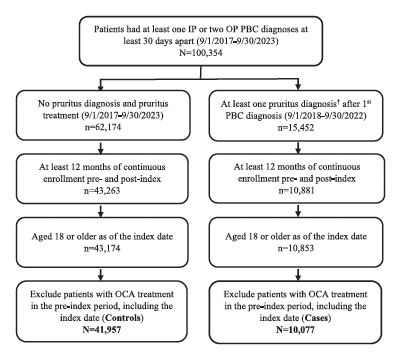
Methods: A retrospective cohort study of individuals with PBC was conducted using Komodo’s claims and laboratory data between September 1, 2017 and September 30, 2023. Individuals’ index date was a randomly selected medical event with (cases) or without pruritus diagnosis (controls) after initial PBC diagnosis. Participants were ≥ 18 years old with continuous insurance eligibility for ≥ 12 months before and after their index, excluding those on obeticholic acid during baseline. Negative binomial models estimated HCRU rate ratios, and linear models estimated incremental all-cause total costs (2024 USD) associated with pruritus, adjusting for baseline demographics and clinical characteristics.
Results: 10 077 patients with PBC and pruritus and 41 957 controls (PBC only) were identified. Regression-adjusted HCRU rate ratios for pruritus vs. controls were 1.69 (inpatient), 1.36 (outpatient), 1.65 (emergency), and 1.44 (prescription counts) and one-year adjusted healthcare costs averaged $39 949 for pruritus and $25 695 for controls, with an incremental cost of $14 254 (all p < 0.001). In sensitivity analyses, incremental costs ranged from $11 495 (using a broader definition of pruritus diagnosis or treatment) to $27 669 (using a stricter definition of pruritus diagnosis and treatment within ±90 days of diagnosis; both p < 0.001).
Conclusion: Pruritus significantly increases HCRU and costs in PBC, highlighting the economic argument for improved management. Further research should assess the effectiveness of novel PBC therapies in slowing liver disease progression and mitigating pruritus symptoms concomitantly.